
The Ultimate Self-Guided Walking Tour of Old San Juan
Old San Juan is one of the most walkable historic districts in the Caribbean. In under two miles, you can walk from a 16th-century fort to a neon-blue cobblestone street to a café serving the best cortadito you’ve ever had — all without needing a car, a tour bus, or a guide with an umbrella.
Here’s how to do it yourself.
Why Self-Guided Is the Way to Go
Guided walking tours in Old San Juan typically last 90 minutes, hit 5-6 stops, and cost $30-50 per person. You walk at someone else’s pace, stop when they stop, and leave when they leave.
A self-guided tour flips all of that:
- Go at your own pace — spend 20 minutes at a fort or 2 hours
- No per-person fees — one purchase covers your whole group
- Pause anytime — stop for lunch, duck into a shop, take a detour
- Works offline — no cell service needed once you’ve downloaded it
The entire historic zone is roughly 7 blocks wide and half a mile long. You can see the highlights in 2-3 hours, or spend a full day exploring every corner.
The Route: What to See and in What Order
Here’s a walkable route through Old San Juan’s most important landmarks, starting from the cruise port area and working west toward El Morro.
Stop 1: Castillo San Cristóbal
Start at the largest fortification built by the Spanish in the New World. San Cristóbal covers 27 acres and rises 150 feet from the Atlantic shoreline. Construction began in 1634, and the fort helped repel 7,000 British soldiers under General Ralph Abercromby in 1797.
Don’t miss the Garita del Diablo (Devil’s Sentry Box), one of Old San Juan’s most iconic and photographed structures.
Entry fee: $10 per person (covers both forts). Kids 15 and under are free. National Parks passes accepted.
Stop 2: Plaza de Colón
A 5-minute walk south from San Cristóbal brings you to Columbus Square, created in the 1890s to mark the 400th anniversary of Columbus’s first expedition. The towering statue of Columbus sits on a pillar at the site of the former Puerta Santiago gate, where the city wall was torn down in 1897.
Stop 3: Catedral de San Juan Bautista
Continue down Calle del Cristo to reach the second-oldest cathedral in the Americas and the oldest church on U.S. soil. First built in 1521, destroyed by a hurricane, and rebuilt in 1540, the cathedral holds the marble tomb of Spanish explorer Juan Ponce de León.
Stop 4: Calle Fortaleza (Umbrella Street)
One of Old San Juan’s oldest streets and easily its most photographed. Famous for the colorful decorative canopies suspended overhead — historically umbrellas, now rotating installations of butterflies, kites, and an enormous Puerto Rican flag.
Stop 5: La Fortaleza
The oldest executive mansion in continuous use in the Western Hemisphere, built between 1533 and 1540 by order of King Charles I of Spain. Originally a fortress, it was repurposed as the governor’s residence when El Morro was completed. It’s been remodeled to its present Neoclassical style since 1846 and is a UNESCO World Heritage Site.
Stop 6: Paseo de la Princesa
Walk south to the tree-lined esplanade that runs just outside the city walls. Built in the 1850s in honor of a Spanish princess, the promenade features the Raíces Fountain at its western end, street vendors, art exhibits, and live music on weekends. It fell into disrepair in the 20th century but was beautifully restored in 1989.
Stop 7: Puerta de San Juan
The only remaining city gate on the walls of Old San Juan. Originally called the Water Gate, this was the historic entrance point where Spanish dignitaries entered the city after arriving by ship. Walk through it — you’re following in 500 years of footsteps.
Stop 8: Cementerio Santa María Magdalena de Pazzis
Just outside the walls of El Morro, this oceanfront cemetery (opened 1865) features brilliant white statuary and a circular red-domed neoclassical chapel. Built facing the Atlantic, symbolizing the journey of souls to the afterlife. Considered one of the most beautiful cemeteries in the world.
Stop 9: Castillo San Felipe del Morro (El Morro)
End at the crown jewel. Construction began in 1539 and wasn’t completed until 1790 — a 250-year building span. Six levels rise 140 feet from the Atlantic, with walls 18 to 25 feet thick. The wide lawn in front is perfect for flying kites (a local tradition) and catching your breath after the walk.
Distance between the two forts: About 0.75 miles along the northern city wall, or roughly 15-20 minutes of walking.
The Blue Cobblestones
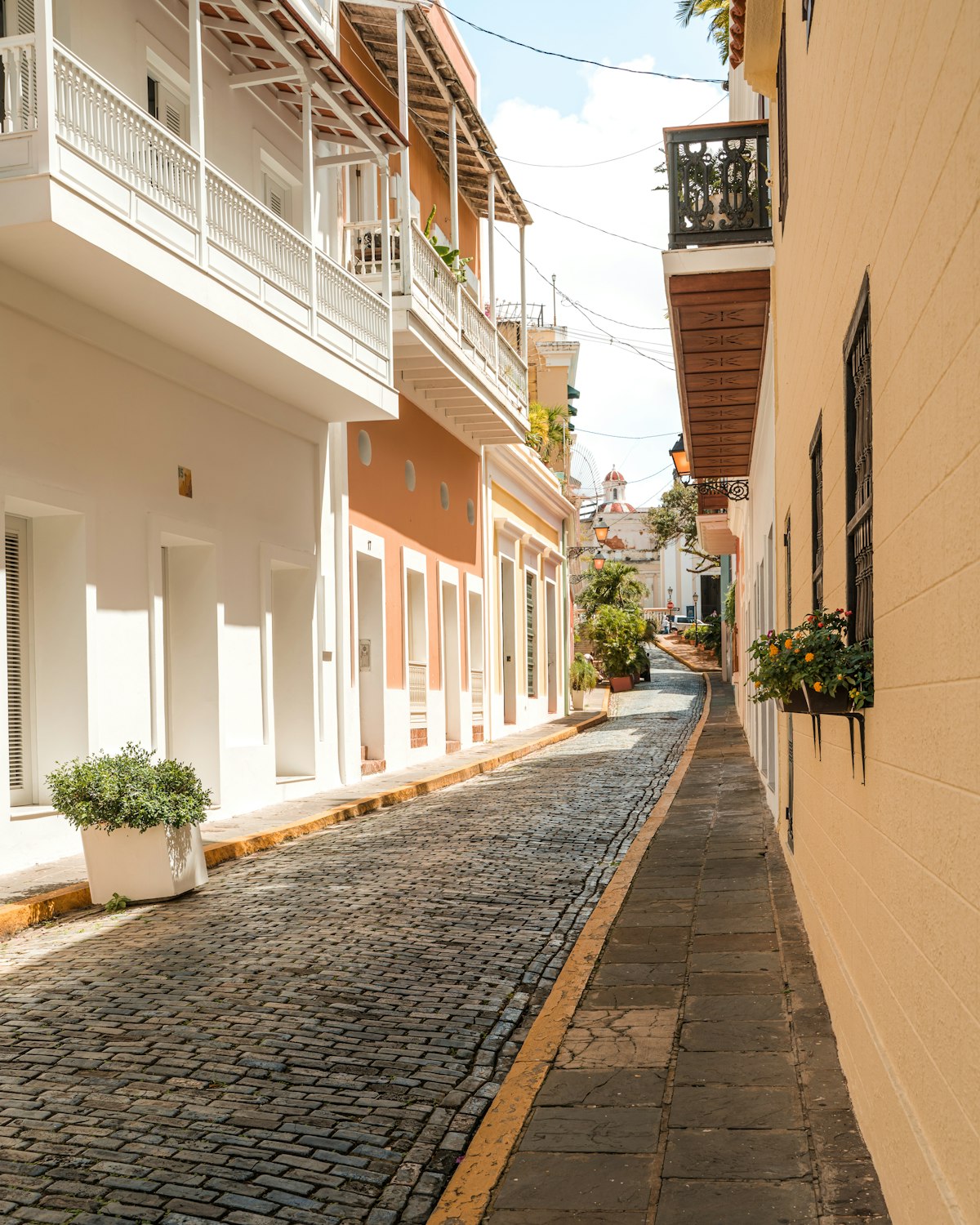
You’ll notice them immediately — the distinctive blue-grey streets underfoot throughout Old San Juan. These aren’t natural stone. They’re cast from iron furnace slag, brought from England as ballast in ships that needed weight for stability on their return voyages.
Once in San Juan, the dense slag bricks were offloaded and repurposed as street pavers. The blue tint isn’t original — it develops over decades of exposure to tropical rain and humidity. The cobblestones were also laid in patterns that channel rainwater to prevent flooding on the hilly streets.
You’ll find them on Calle del Cristo, Calle Fortaleza, and the streets surrounding Plaza de Armas.
Where to Eat Along the Way
For Traditional Puerto Rican Food
Raíces (315 Calle Recinto Sur) — The name means “roots.” This is the go-to spot for mofongo, chuleta kan-kan, and arroz con gandules. Staff wear traditional attire. Gets crowded when cruise ships are in port, so arrive early.
Barrachina (104 Calle Fortaleza) — Set in a colonial building with a lush interior courtyard. Claims to be the birthplace of the piña colada, created in 1963 by bartender Don Ramón Portas Mingot (the Caribe Hilton disputes this). A bronze plaque outside commemorates the claim.
For Coffee and Breakfast
Cuatro Sombras (259 Calle Recinto Sur) — Old San Juan’s first micro-roastery. Single-origin 100% Arabica beans from Yauco, Puerto Rico, roasted on-site. Try the guava butter croissant.
Cafetería Mallorca (300 Calle San Francisco) — An old-school cafeteria famous for the mallorca sandwich: a soft, buttery bun pressed on a hot griddle, filled with ham, cheese, and egg, then dusted with powdered sugar. The bun descends from the Spanish ensaïmada brought by Balearic Island immigrants.
For a Special Dinner
Marmalade (Calle Fortaleza) — Multi-course tasting menus. The top choice for a special occasion in Old San Juan.
Practical Tips
Best time to go: Mid-December through April is dry season. Start early morning — the streets are cooler, cruise ship crowds haven’t arrived yet, and the light is beautiful for photos.
What to wear: Flat, closed-toe walking shoes are essential. The cobblestones are uneven, streets are hilly, and flip-flops will ruin your feet. Bring sunscreen, a hat, and a water bottle. A light rain jacket is smart — tropical showers are sudden.
How long it takes: 2-3 hours for the highlights. 4-5 hours if you tour the fort interiors, shop, and eat. A full day if you want to soak it all in.
Fort entry fees: $10 per person covers both El Morro and San Cristóbal. Valid for two consecutive days. Kids 15 and under enter free.
Frequently Asked Questions
Can I walk from the cruise port to Old San Juan? Yes — if you dock at the Old San Juan piers (Piers 1-4), you’re already there. Landmarks are 5-15 minutes on foot. If you dock at the Pan American Pier, you’ll need a short taxi ride.
Do I need cell service? Not if you prepare ahead. Download your tour or maps before you go. Tour in a Box works entirely offline after download.
Is Old San Juan safe to walk? Yes. Old San Juan is one of the safest areas in Puerto Rico, with a steady tourist and local presence throughout the day. Standard travel precautions apply.
How much walking is involved? The full route covers about 1.5-2 miles. Add shopping and exploring, and you could log 5+ miles in a day.
Is it stroller-friendly? Mostly, but cobblestone streets and some steep hills can be challenging. An all-terrain stroller is recommended.
Want to turn this walk into an adventure? Our San Juan scavenger hunt tour adds interactive riddles at every stop, local food recommendations, and works entirely offline. One purchase covers your whole group.
Explore San Juan yourself
Interactive scavenger hunt tour. Solve riddles, discover history, find local gems.
See the San Juan Tour