
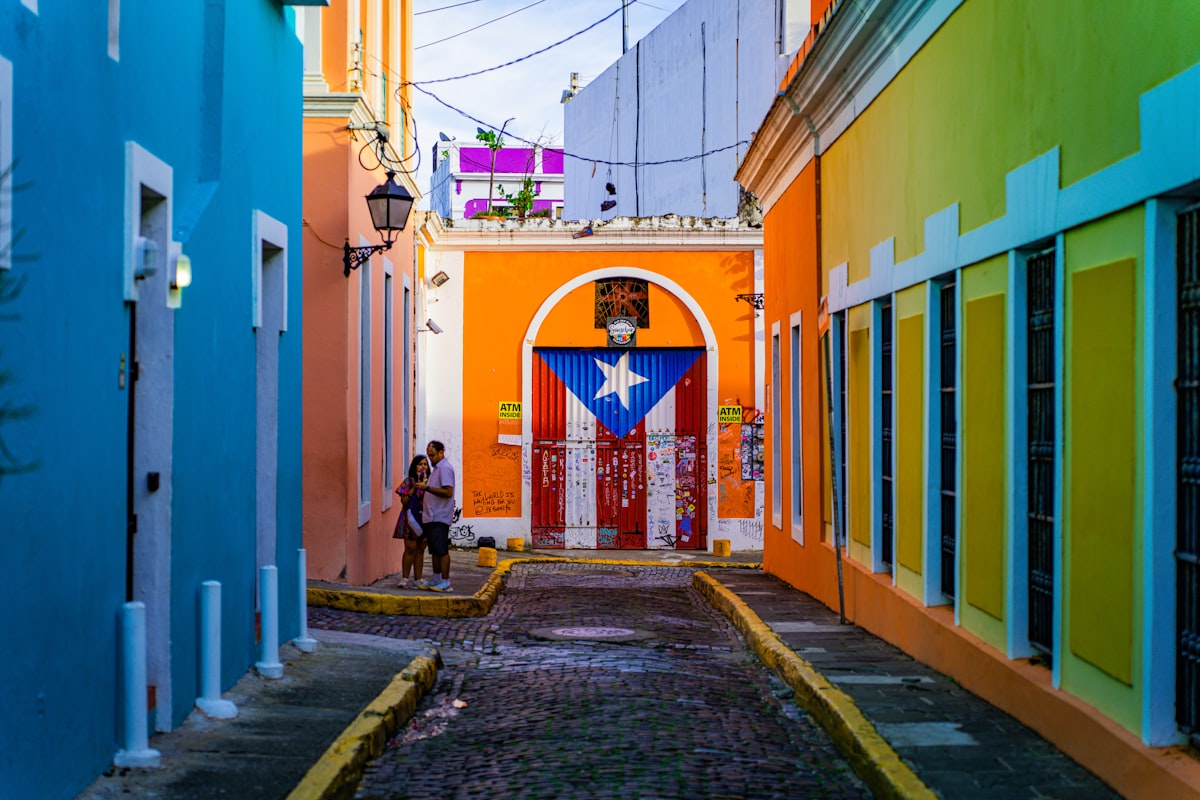
15 Hidden Gems in Old San Juan Most Tourists Miss
Everyone knows about El Morro. Everyone photographs Umbrella Street. But Old San Juan is a 500-year-old city packed into seven blocks — and most of its best stories are hidden behind unmarked doors, down overlooked alleys, and beneath the surfaces that tourists walk across without a second glance.
Here are 15 spots most visitors never find.
1. La Factoría — The Seven-Room Speakeasy
148 Calle de San Sebastián
There’s no sign. Just an unmarked door at the corner of Calle San Sebastián and Calle San José. Behind it lies one of the Caribbean’s most celebrated bars — a labyrinth of six to seven distinct rooms, each with its own ambiance, drink menu, and music.
The front bar (“La Facto”) was formerly the legendary Café Hijos de Borinquen. Push through swing doors and you reach Vino, a wine bar curated by sommelier Franco Buso. Deeper still, El Desvío is a candlelit room hidden behind a corridor, and the Red Room features neon lights and a DJ booth where the party runs until the early hours.
Named to the World’s 50 Best Bars list in 2014. Repeatedly named Best Bar in the Caribbean.
2. Plaza de la Rogativa — The Legend That Scared Off the British Navy
Hidden behind San Juan Cathedral, this small plaza commemorates one of Puerto Rico’s most remarkable stories. In 1797, when the British fleet under Sir Ralph Abercromby besieged San Juan, the bishop led a procession of women carrying torches and ringing bells through the streets. The British mistook the torchlight for arriving Spanish reinforcements and abandoned the siege entirely.
The bronze sculpture by New Zealand artist Lindsay Daen was installed in 1971. Few tourists find this intimate plaza, but it offers some of the best sunset views of San Juan Bay and La Fortaleza.
3. Paseo del Morro — The Trail Beneath the Walls
Everyone visits El Morro from the top. Almost no one walks the trail at its base.
This 3/4-mile paved trail runs along the bottom of the massive city walls from the San Juan Gate westward, hugging San Juan Bay the entire way. Originally a maintenance road for the city walls, it was opened to the public in 1998 and designated a National Recreational Trail in 2001.
Along the way you’ll pass stone garitas (sentry boxes) perched over crashing waves, and at sunset the ancient walls glow amber. It’s completely unshaded — bring water.
Bonus: This is also where Old San Juan’s famous cat colonies live. The nonprofit Save a Gato has managed them since 2004 through trap-neuter-return programs. At sunset, volunteers drive a golf cart with food along the trail and the cats emerge from hiding spots in the rocks.
4. Capilla del Santo Cristo de la Salud — The Miracle Chapel
Bottom of Calle del Cristo
This tiny baroque chapel was built in 1753 to commemorate a miracle. During the San Juan Bautista celebrations, a rider named Baltazar Montañez lost control of his horse and plunged over the cliff. The Secretary of Government allegedly cried out, “Christ of Good Health, save him!” — and the rider survived.
Inside, the altar is adorned in silver and gold leaf, surrounded by oil paintings from renowned Puerto Rican artist José Campeche. You can see miniature silver ornaments shaped like body parts (called milagros) left by pilgrims seeking healing.
Here’s why most tourists miss it: The chapel is only open on Tuesdays and religious holidays. Everyone else finds a locked door and moves on.
5. Casa Blanca — The Oldest Occupied House in the Western Hemisphere
1 Calle San Sebastián
Built in 1521 as a residence for Juan Ponce de León’s family (though Ponce de León himself died before he could live there), Casa Blanca has been continuously occupied for over 500 years — by his descendants, then the Spanish military, then the U.S. military until 1966.
The museum inside is worth a quick look, but the real hidden gem is the walled garden: lush tropical plantings, stone fountains, mature shade trees, and views of the bay. The gardens are free to enter, open 7 days a week, 9am-4pm — even when the museum is closed.
6. El Batey — The Dive Bar From Hunter S. Thompson’s Era
101 Calle del Cristo
Established in 1961 in an 18th-century colonial building, El Batey is one of the last surviving bars from the San Juan that Hunter S. Thompson chronicled in The Rum Diary. The walls are covered floor-to-ceiling in graffiti left by decades of visitors. There’s no cocktail menu — just beer, rum, and a jukebox.
This is the opposite of a craft cocktail bar. It’s a gritty, unapologetic time capsule where locals and curious visitors share stories over cheap drinks. If you want the polished Old San Juan, skip it. If you want the real one, sit down.
7. The Marquette Building’s Lobby (of Iglesia San Francisco de Asís)
Most tourists visit the Cathedral, but the Church of Saint Francis (rebuilt 1770) hides two remarkable secrets. A short staircase leads down to catacombs in the basement containing actual graves. And the church houses El Cristo de Buen Viaje (Christ of Good Voyage) — a large crucifix that was recovered from a sunken ship off the coast of San Juan.
The beautifully restored reliefs and murals inside are worth the visit alone.
8. La Casa del Libro — 6,000 Rare Books Hidden in a Colonial House
255 Calle del Cristo
Founded by Princeton University retiree Elmer Adler, who visited Puerto Rico in 1954 and never left, this museum-library houses over 6,000 rare volumes. The collection includes incunabula — books printed between 1450 and 1501, among the oldest printed works in existence. It’s the largest rare books collection in Puerto Rico and the Caribbean.
Free admission (a $2 donation is suggested). Open Tuesday through Saturday, 11am to 4:30pm. Almost nobody visits.
9. Parque de las Palomas — The Cannon-Socket Pigeon Park
Located next to Capilla del Cristo, this tree-shaded cobblestone park sits on top of the old city wall. In the 18th century, cannons were positioned here to defend the southeastern coast. After the cannons were removed, pigeons began nesting in the empty cannon sockets — and they’ve been there ever since.
Hundreds of pigeons now call the park home. The elevated position offers sweeping views of San Juan Bay, and it’s a surprisingly peaceful place to sit for 10 minutes away from the tourist foot traffic below.
10. Plaza del Quinto Centenario & the Totém Telúrico
This multilevel granite plaza, unveiled in 1992, commemorates the 500th anniversary of Columbus’s arrival. Its centerpiece is the Totém Telúrico — a towering 40-foot sculpture by Puerto Rican ceramist Jaime Suárez.
Here’s what makes it special: the totem is made from broken fragments of ceramic vases and clay pottery from across the Americas, a direct allusion to the pottery fragments of the indigenous Taíno people found at archaeological sites throughout Puerto Rico. Most tourists walk through the plaza without understanding what they’re looking at.
11. The Blue Cobblestones — What You’re Actually Walking On
You’ve walked on them for hours without knowing the story. The distinctive blue-grey streets of Old San Juan aren’t natural stone — they’re cast from iron furnace slag, the waste product of smelting.
In the 16th century, Spanish ships carried these heavy blocks as ballast on the empty voyage to Puerto Rico, then offloaded them before filling the ships with gold and sugar. The stones were repurposed as street pavers. The blue color isn’t original — it developed over centuries of exposure to tropical rain and humidity.
Look down at Calle del Cristo. You’re walking on 500-year-old recycled industrial waste from European foundries.
12. The Cemetery You Should Actually Walk Into
Cementerio Santa María Magdalena de Pazzis
Everyone photographs this clifftop cemetery from the walls of El Morro. Almost nobody walks inside. Dating to 1863, it sits on a cliff overlooking the Atlantic, reached through a tunnel leading to the main gate.
Inside: elaborate neoclassical monuments and the graves of Puerto Rican national figures — independence leader Pedro Albizu Campos, poet Julia de Burgos, actor José Ferrer, and composer Rafael Hernández. The white statuary against the blue ocean is hauntingly beautiful. Free to visit during daytime hours.
13. Princesa — Cocina Cultura
Paseo de la Princesa
Tucked away on the harbor side of Paseo de la Princesa, facing the historic Spanish Arsenal piers, this restaurant serves elevated Puerto Rican cuisine in a lush tropical garden setting with an impressive rum bar. Many locals call it their favorite restaurant in Old San Juan. It’s easy to miss because it sits off the main tourist streets — which is exactly the point.
14. Museo Felisa Rincón de Gautier
This free museum honors Felisa Rincón de Gautier, the trailblazing first female mayor of San Juan (served 1946-1968). Located in her former home, it contains personal artifacts, photographs, and documents highlighting her contributions to public health, education, and social services.
A remarkable woman’s story in a city that doesn’t lack for remarkable stories. Free admission. Almost completely unknown to tourists.
15. The Secret Beach Below the City Walls
Playa Peña
Old San Juan has a beach. Most visitors have no idea. Playa Peña is a small, rocky beach tucked below the city walls, accessible via a path near the San Juan Gate. It’s not a resort beach — there are no chairs, no umbrellas, no vendors. But the views of the walls rising above you and the Atlantic stretching in front of you make it one of the most uniquely situated spots in the Caribbean.
How to Find These Places
That’s the challenge with hidden gems — they’re hidden. Most require knowing exactly where to look, which streets to turn down, and which doors to try.
A scavenger hunt tour helps. Instead of following a standard tourist route, you’re solving riddles that lead you to unexpected locations, looking closely at details most visitors miss, and discovering the stories behind places you’d otherwise walk right past.
Frequently Asked Questions
Is La Perla safe to visit? La Perla is the colorful neighborhood between the city walls and the ocean, famous from the “Despacito” video. Visit only during the daytime and ideally with a local guide. There’s a no-photography rule — residents don’t want tourists photographing their homes without permission.
When is the best time to explore hidden gems? Early morning or late afternoon. The streets are emptier, the light is better, and you’ll have places like Plaza de la Rogativa almost entirely to yourself.
Can I see all 15 in one day? Technically yes — they’re all within a 20-minute walk of each other. But the point of hidden gems is to slow down and soak them in. Pick 5-7 and give yourself an unhurried half day.
Are these spots wheelchair accessible? Some are (Paseo del Morro, most plazas), but Old San Juan’s cobblestone streets and hilly terrain make full accessibility challenging. Check specific venues for accessibility information.
Discover Old San Juan’s hidden side. Our San Juan scavenger hunt tour takes you to 12 stops — including several spots most tourists miss. Solve riddles, uncover hidden history, and get local food recommendations at every stop. One purchase covers your whole group.
Explore San Juan yourself
Interactive scavenger hunt tour. Solve riddles, discover history, find local gems.
See the San Juan Tour