
Chicago Architecture Walk: A Self-Guided Route Through the Loop
Chicago is where the skyscraper was born. After the Great Fire of 1871 destroyed much of the city, architects had a blank canvas and an urgent need to rebuild. New fire codes eliminated wood construction. Steel-skeleton frames freed buildings from load-bearing walls. The safety elevator made height practical. And economic pressure on limited downtown land meant the only direction to grow was up.
The result is the most architecturally significant skyline in America — and you can walk through 150 years of it in about 3 miles.
The Route: 14 Stops Through the Loop
This route covers the major architectural landmarks in a logical walking order, starting at the southern end of the Loop and working north to the Chicago River and beyond. Total distance: approximately 3 miles. Time: 2-3 hours at a steady pace, longer if you linger.
Stop 1: Chicago Board of Trade Building
141 W. Jackson Blvd. | Holabird & Root, 1930 | Art Deco
Start at the bottom of LaSalle Street’s famous canyon. This Art Deco tower is clad in grey Indiana limestone with a copper pyramid roof. At the top stands a 31-foot, 6,500-pound faceless aluminum statue of Ceres, Roman goddess of grain.
Detail most people miss: Ceres has no face. Sculptor John H. Storrs deliberately left it blank because he believed no one would ever be tall enough to see it. The irony arrived decades later as taller buildings rose around it.
Stop 2: Monadnock Building
53 W. Jackson Blvd. | Burnham & Root (1891) / Holabird & Roche (1893)
This single building tells the story of how architecture changed forever. The north half (1891) is one of the last great load-bearing masonry buildings — its walls are 6 feet thick at the base. The south half (1893) uses a modern steel skeleton frame.
Walk from one end to the other. You’re literally crossing the divide between old and new construction technology. The walls flare outward at the base like an Egyptian pylon because they have to — all that stone is holding itself up.
Stop 3: Marquette Building
140 S. Dearborn St. | Holabird & Roche, 1895 | Chicago School
The exterior is dignified but understated. The lobby is the treasure. Step inside to see Tiffany mosaics by Louis Comfort Tiffany depicting scenes from explorer Jacques Marquette’s journey — made with lustered glass, mother-of-pearl, and semi-precious stones. The bronze elevator doors feature intricate carvings of panther heads.
Free to walk into during business hours. Most tourists never step inside.
Stop 4: Chicago Federal Center & Flamingo
219 S. Dearborn St. | Mies van der Rohe, completed 1974 | International Style
Three buildings define a stark, geometric plaza: the 30-story Dirksen Courthouse, the 42-story Kluczynski Building, and a single-story Post Office. In the center stands Alexander Calder’s “Flamingo” (1974) — a 53-foot, 50-ton vermillion-red steel sculpture whose curves deliberately contrast with Mies’s rigid right angles.
The tension between the sculpture and the architecture is the point. Calder’s organic forms against Mies’s industrial minimalism.
Stop 5: Rookery Building
209 S. LaSalle St. | Burnham & Root, 1888 | Romanesque Revival exterior
One of the oldest surviving skyscrapers in Chicago. The building is named for the pigeons (“rooks”) that roosted on the temporary city hall that previously stood on this site.
The lobby is the star: a soaring two-story light court capped by a skylight, redesigned by Frank Lloyd Wright in 1905. Wright layered white marble and gold-leaf ornamentation over Root’s original ironwork. Free to visit during business hours — just walk in.
Stop 6: Reliance Building (Hotel Burnham)
32 N. State St. | Burnham & Atwood, 1895 | Chicago School
This 14-story building was revolutionary. The steel frame supports a thin curtain wall of large glass windows and white glazed terra-cotta tiles. It anticipated the glass-and-steel towers of the mid-20th century by 60 years.
Look at it and think about the fact that when this was built, most buildings still relied on thick masonry walls to hold themselves up. This was the future, realized in 1895. Now houses the Staypineapple Hotel.
Stop 7: Sullivan Center (Carson, Pirie, Scott Building)
1 S. State St. | Louis Sullivan, 1899/1903-04 | Chicago School
Sullivan’s masterwork of “form follows function.” The upper floors are a rational grid of large Chicago windows. But the ground-floor entrance is pure Sullivan: elaborate, swirling cast-iron ornament in organic patterns.
Get close to the corner entrance rotunda. The ironwork is some of the most intricate decorative metalwork ever produced in America — impossibly detailed organic patterns that reward close examination with layers of detail invisible from even a few feet away.
Stop 8: Daley Plaza & The Picasso
50 W. Washington St.
The untitled Picasso sculpture (1967) was the first major abstract public artwork in downtown Chicago. It stands 50 feet tall, weighs 162 tons, and is made of COR-TEN steel that weathers to a rust-brown patina.
Picasso reportedly said it represented the head of his Afghan Hound, Kabul. Others see a woman, a bird, or something else entirely. Its installation launched Chicago’s tradition of commissioning monumental public art — the Flamingo, Cloud Gate, and dozens more followed.
Stop 9: Carbide and Carbon Building
230 N. Michigan Ave. | Burnham Brothers, 1929 | Art Deco
One of Chicago’s most striking buildings. The facade is polished black granite and dark green terra cotta with gold-leaf trim at the top. It’s rumored to have been inspired by a champagne bottle — dark green body, gold foil top.
Now houses the Pendry Chicago hotel. The “Burnham Brothers” were Daniel H. Burnham Jr. and Hubert Burnham, sons of the legendary Daniel Burnham.
Stop 10: Wrigley Building
400-410 N. Michigan Ave. | Graham, Anderson, Probst & White, 1921-24 | French Renaissance Revival
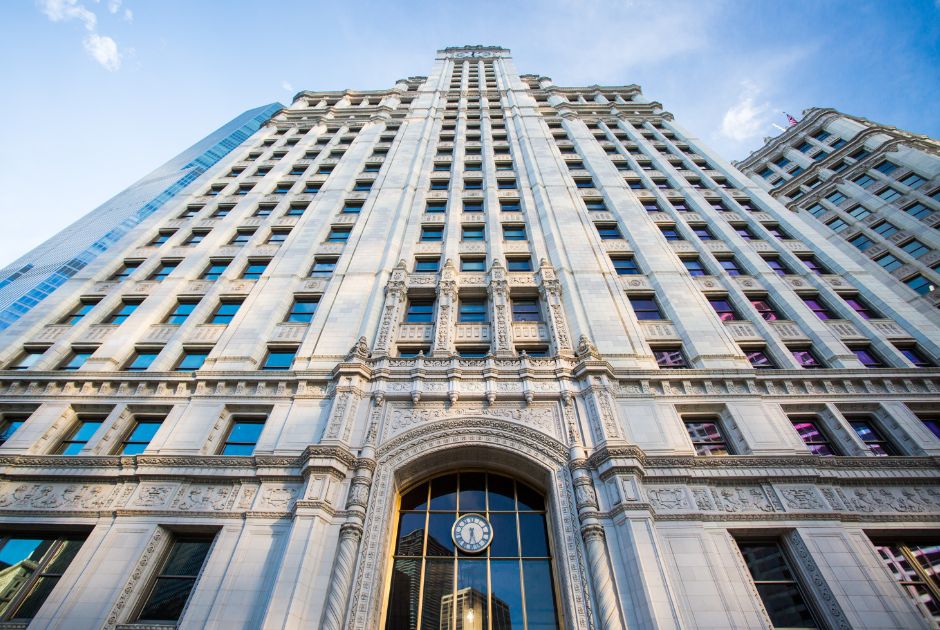
Two gleaming white towers clad in over 250,000 glazed terra-cotta tiles. The south tower’s clock has four faces, each 19 feet 7 inches in diameter.
Detail most people miss: The building uses six different shades of white terra cotta, graduating from darker at the base to brighter at the top. This creates the illusion of the building being taller than it is and catches sunlight differently throughout the day.
Stop 11: Tribune Tower
435 N. Michigan Ave. | Hood & Howells, 1925 | Gothic Revival
Won a 1922 international design competition that drew 260+ entries. The crown features flying buttresses modeled after the Tour de Beurre of Rouen Cathedral.
The hidden detail: Walk around the base at street level. Embedded in the exterior walls are approximately 150 fragments of famous structures from around the world — the Great Wall of China, the Great Pyramid at Giza, the Parthenon, the Hagia Sophia, the Taj Mahal, Notre-Dame, the Berlin Wall, St. Peter’s Basilica, and the White House. Each fragment is labeled. The tradition started in 1914 when publisher Robert McCormick grabbed a piece of a WWI-damaged cathedral in Belgium. Most people walk right past without looking down.
Stop 12: 330 North Wabash (IBM Building)
330 N. Wabash Ave. | Mies van der Rohe, completed 1972 | International Style
The last building Mies designed in Chicago before his death in 1969. At 52 stories and 695 feet, its black anodized aluminum and bronze-tinted glass create a powerful dark silhouette against the sky.
Now houses The Langham Chicago hotel on floors 2-13. The lobby features marble, granite, and travertine in Mies’s spare, elegant style.
Stop 13: Marina City
300 N. State St. | Bertrand Goldberg, 1961-68 | Modernist
The iconic “corn cob” towers. Goldberg — a former student of Mies van der Rohe — believed that since no right angles exist in nature, none should exist in architecture. Every room in every apartment is wedge-shaped.
The bottom 19 floors of each tower are an open-air spiral parking garage (visible from the river). Above that: 896 pie-shaped apartments. The complex was a true “city within a city” — originally including a theater, bowling alley, ice rink, gym, and marina.
Stop 14: Aqua Tower
225 N. Columbus Dr. | Jeanne Gang / Studio Gang, 2009 | Contemporary
End at the building that proved architecture isn’t done evolving. The undulating concrete balconies ripple outward at different lengths on every floor, evoking waves of water. This isn’t just aesthetic — the curves diffuse strong winds, allowing usable outdoor space on every level.
No two floors are identical. Gang studied the topography of Great Lakes limestone strata to develop the flowing forms. When completed, it was the tallest building in the world designed by a woman — 82 stories, 859 feet.
Best Photography Spots Along the Route
- LaSalle Street Bridge — The iconic canyon view south toward the Board of Trade, with the L train overhead
- Michigan Avenue Bridge (DuSable Bridge) — Four-direction views of the Wrigley Building, Tribune Tower, and the river
- The Riverwalk — The urban canyon of towers reflected in the water, with iron bridges for composition
- Cloud Gate at Millennium Park — The Bean’s mirrored surface reflects the entire skyline (short detour east from the route)
Tip: Golden hour and just after sunset (“blue hour”) produce the best results. After rain, the Riverwalk surfaces create reflections.
The Chicago Architecture Center
If you want to go deeper, visit the Chicago Architecture Center at 111 E. Wacker Drive. Admission is $15 for adults. Inside: the Chicago City Model Experience with over 4,200 individual miniature buildings, plus exhibits on how the city was built.
They also run over 85 guided walking, bus, and boat tours — including the famous river cruise on the First Lady, rated the #1 boat tour in the U.S.
Frequently Asked Questions
How long does this walk take? 2-3 hours at a moderate pace, covering about 3 miles. If you stop to explore building lobbies (Rookery, Marquette) and photograph details (Tribune Tower stones, Sullivan Center ironwork), plan for 3-4 hours.
Is this walk flat? Yes. The Loop is essentially flat. No hills, no stairs between stops.
Can I do this walk in winter? Yes, but dress warmly — the wind between buildings is real. Winter has one advantage: the low sun creates dramatic shadows on building facades and clearer visibility.
Do I need to go inside any buildings? No, but you should. The Rookery lobby (Frank Lloyd Wright) and Marquette Building lobby (Tiffany mosaics) are both free and open during business hours. They’re two of the best interiors in the city.
Is there an entry fee for any stops? No. Everything on this route is a public street, plaza, or free-to-enter lobby. Only the Chicago Architecture Center charges admission ($15).
Turn this walk into an adventure. Our Chicago scavenger hunt tour takes you through 11 landmark stops with interactive riddles, hidden history, and local food recommendations. One purchase covers your whole group, and it works entirely offline.
Explore Chicago yourself
Interactive scavenger hunt tour. Solve riddles, discover history, find local gems.
See the Chicago Tour